

Information Asymmetry
I was listening to a recent podcast episode from Tens and Aces about slot advantage plays, and the guest mentioned Information Asymmetry and it triggered some thoughts about how churners navigate IA. Information asymmetry at its simplest is when one party has more or better information than the other. Why is this important? Well let’s imagine you are buying a used car. You only know what the car looks like, what the mechanic reports say, and the price you agreed on. The seller on the other hand, might notice that between the last maintenance check and now, some weird noises from the transmission started happening (I’m not a car guy). It only happens from time to time, but it does happen, they know about it and you don’t. This asymmetry creates a disadvantage for you, the buyer because you lack all relevant information about the car to help determine if this is a good deal for you or not. The balance of power has shifted to the seller.
In the world of consumer protection, we even have "Lemon Laws" specifically designed to bridge this information gap, giving the buyer a safety net when the seller’s hidden knowledge turns into a mechanical nightmare. These laws acknowledge that as a buyer, you are often "betting" that the car is as good as the seller claims, while the seller is simply offloading a liability they’ve known about for months. The legal system tries to level the playing field, but the fundamental tension remains: the seller wants to sell a "lemon" at "peach" prices, and the buyer is desperate to avoid being the sucker. In any high-stakes transaction, the party with the hidden data holds the leverage—until the other side figures out how to screen for the truth. But what happens when the roles are reversed—when the 'buyer' is the one hiding their true nature from a massive corporation that is desperate to find a 'peach' but keeps accidentally inviting 'lemons' to the party?
Banks attract customers with a "Bible-length" credit book, fancy card designs, and massive welcome offers. When you see someone flash an Amex Platinum with that new mirror finish, the immediate thought is often, "That person is wealthy." This is the power of Signaling Theory in action: the card itself is a signal of status and spending power. However, beneath the surface of these glossy offers, two very different types of people are biting the hook.
Imagine the churning community as the "Buyer" (the Lemon) and your average, Dave Ramsey-worshiping consumer as the "Peach."
The Average Joe (The Peach) sees:
The Points: "That’s a huge number. I’ll probably just redeem them for a gift card or a statement credit."
The Credits: "I’ve never heard of these brands, but I’m sure I’ll use them eventually."
The Spend: "I don't usually spend this much, but maybe I'll splurge on a few big purchases this month."
The Churner (The Lemon) sees:
The Points: "I can transfer these to a partner for a business class flight to Italy, or sell them if the value is right."
The Velocity: "How fast can I hit this Minimum Spend Requirement (MSR) so I can move on to the next issuer?"
The Loophole: "I’ve had this card before, but I found a 'No-Lifetime-Language' link to bypass the lockout."
The bank's business model relies on the Peaches to eat the cost of the Lemons. They count on ‘average joes’ who forget to use their credits, use them incorrectly, or—most importantly—carry a balance. Most churners are actually highly responsible and financially stable; their risk isn't default, it's profitability.
In this scenario, the information asymmetry is the user's true intent. The bank can see your credit score, but they can't see your spreadsheet or your TravelFreely app. They don't know if you're a profitable Peach or a cost-heavy Lemon. When a bank rolls out a massive 300k-point offer, they are essentially shouting into a crowded room, hoping for Peaches. But because of this asymmetry, they face adverse selection: the higher the offer, the more they attract the "wrong" crowd—the churners who are best equipped to extract every cent of value and vanish.
To combat this, banks have to develop "screening" mechanisms. Since they can't read your mind, they look for Signals in your data. This is where "Pop-up Jail" comes in. By analyzing your history and spend patterns, the bank tries to "unmask" the Lemon before the transaction is finalized. If the algorithm detects the signals of a churner, it denies the bonus—effectively closing the information gap before the "deal" is even made.
Banks are effectively trying to build a better mousetrap by reading the signals we leave behind. But once you realize you're being screened, the game doesn't end—it just moves underground. This is where the math of the transaction meets the psychology of the community. To keep the information lopsided in our favor, we have to navigate what I call the Churner’s Dilemma.
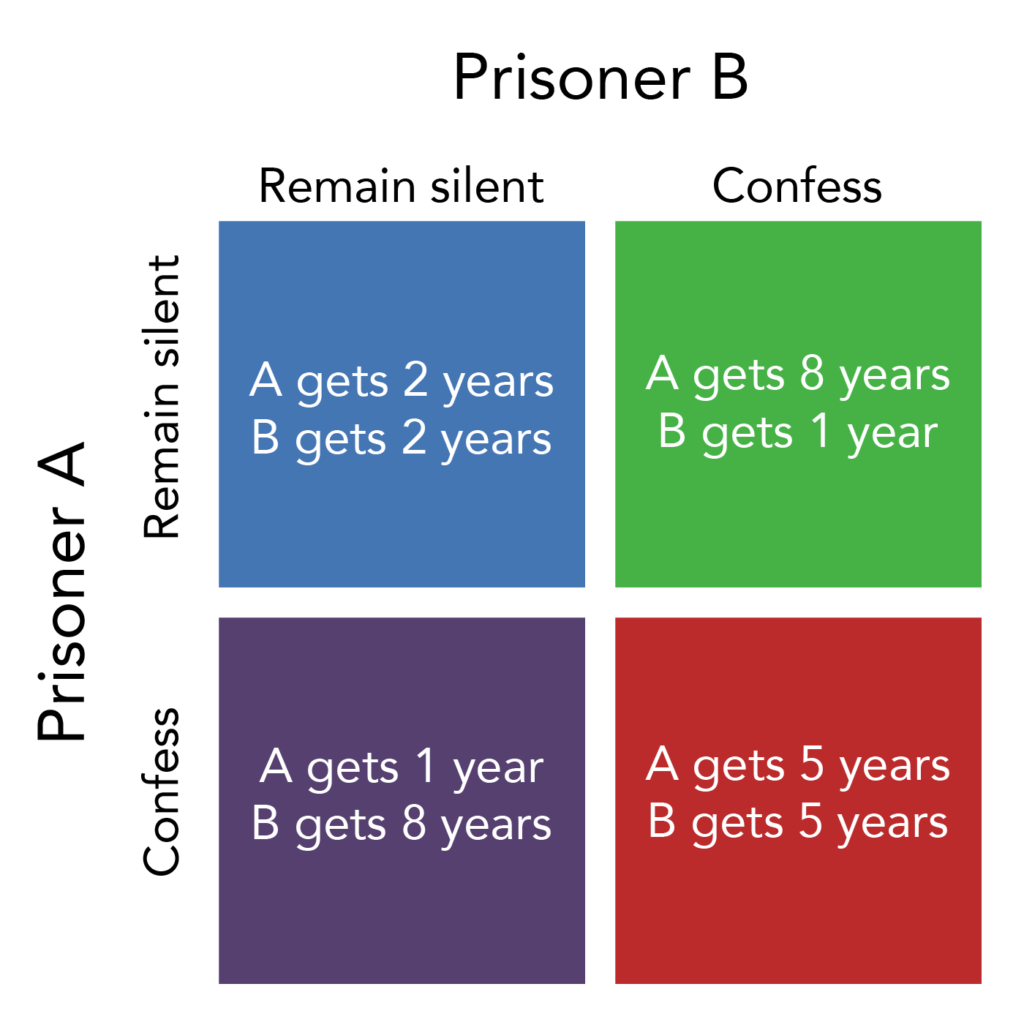
Prisoner’s Dilemma
In Game Theory, the Prisoner’s Dilemma illustrates a brutal truth: the group wins when everyone stays silent, but the individual is constantly tempted to "defect" for a quick gain. In our world, that "defecting" usually looks like a TikToker or a blogger burning a perfectly good "glitch" or a "No-Lifetime-Language" link for three minutes of digital clout. They get the views; the rest of us get the ‘pop up’ or an alpha ruined. That’s why I love MEAB’s blog, they do a great job at leaving hints to make you think but never flat out give plays.
When the asymmetry vanishes, the play dies. The bank’s algorithm is a learning machine, and every time a "secret" goes mainstream, we’re just feeding it the data it needs to close the loophole for good. The real trick to churning isn't just knowing the math; it's knowing when to keep it to yourself.
In a world where everyone is looking for a "peach" and trying to unmask a "lemon," the most valuable information is the kind that doesn't show up in a search engine. The question isn't whether you can find the edge—it's whether you're disciplined enough to keep it sharp.
The bank has the house edge, the actuarial data, and the algorithms. All we have is the silence of the people who know how to play. Once that silence breaks, the asymmetry flips, and the house wins again.